Lamborghini Murcielago LP640 Aerodynamic Package by IMSA

Not many tuners dare to touch the Lamborghinis, but the few who do (Hamann, Edo) do so with great respect for the supercar icon. Imsa, a German high-tech engineering specialist, has developed an Autoclave moulded carbon fibre technology- and design-package for the 'devil' of the Lamborghini line-up. Autoclave moulding is normally a process reserved for F1 and other high-end motorsport racing.

The aggressive new front spoiler aligns perfectly to the, by 35 mm widened, wheel arches. On the upper side of the wheel arches imsa has added air ducts resulting in a reduction of the drag effect caused by non-aerodynamic airflow at higher (and top) speeds. The imsa side skirts garantees optimum airflow to the new rear diffuser which has been developed for a perfect interaction with the imsa rear spoiler.

There is no mention on pricing, but you know what they say, if you have to ask how much, you can't afford it.

Lamborghini Murcielago LP640 Aerodynamic


Press Release

The brand new imsa technical and aerodynamic-enhancement program for the Lamborghini Murcielago LP640

Imsa, the world-acclaimed, German High-Tech Engineering specialist, exclusively presents, after successfully introducing the stunning imsa GTV Supercar based on all versions of the Lamborghini Gallardo, its new technology and design-enhancement program for Lamborghini's current top-of-the-range supercar, the Murcielago LP640.


Special emphasis must be laid on the technology- and design-package made from Autoklav moulded carbon fibre. Technology which is normally only being used in Formula 1 and other Top-motorsports Series.


Imsa's main target was, for all owners of the Lamborghini top-of-the-range-model, to offer an exclusive product line, transforming the Murcielago both technically and optically into a unique work of art, with the aim of significantly enhancing the exclusivity of Lamborghini's top-model.


The strinkingly aggressive and aerodynamically highly effective front apron (spoiler) perfectly aligned to the wheel arches (widened 35mm on each side), directly becomes apparent.


On the upper side of the wheel arches, imsa CFK air ducts have been integrated, resulting in a significant reduction of the drag effect caused by non-aerodynamic airflow at higher and highest velocity.


The imsa side-skirts on the underside guarantee the optimum airflow to the imsa diffuser, which has been developed for an aerodynamically perfect interaction with the imsa rear spoiler. Imsa herewith achieved to considerably lower the downforce at higher and highest speeds.


The benefits for the driver are a significant enhancement of driving stability, safety and enjoyment. All parts of the imsa-aerodynamic-enhancement program are either available in carbon-on-sight or can be painted in any colour of choice.


The imsa aerodynamic-enhancement-program is available from November 2007 on and will soon be available for the "standard" Murcielago as well.


The imsa technical enhancement program also includes - exactly as for the imsa GTV Supercar based on the Lamborghini Gallardo - exclusive imsa multi-part sports wheels with central locking system, various sports chassis with individual settings, and, last but not least, various imsa engine modifications and own engines.


At imsa, each customer is fully involved in the creation of his personal, unique imsa-Megacar handcrafted according to highest German standards of quality and precision.


Additionally, personalised tailor-made interiors inclusive of various multi-media applications are also being fitted on special request.


[source:WorldCarFans]

Mazda 2

The 2’s compact size, light, accurate controls and tight turning circle are great in town, while the quick-witted chassis is well balanced and agile. This is an everyday supermini that’s great fun to drive. The fide is firm, yet because the damping is impressive, it never becomes jittery or loses its composure. Body control is superb – it may not be as grown up as some rivals, but it’s very enjoyable. Both 1.3-litre and 1.5-litre engines feel energetic too, thanks to the low kerb weight, while the gearshift and brakes have impressive feel.

Mazda’s designers chose to make the latest 2 40mm shorter than its predecessor; most rivals are longer, taller and wider, which gives the Japanese hatch a distinct weight advantage. This is great for economy and performance. It doesn’t even look like a heavy car, with athletic, dynamic styling that’s very attractive. There’s a very small range of three trims; 1.3 TS, 1.3 TS2 and 1.5 Sport, all in the single five-door bodystyle. All are very well-equipped – and the company’s straightforward pricing policy means your only option is whether to choose metallic paint. Related to the Ford Fiesta, other rivals include the Renault Clio III, Vauxhall Corsa, Honda Jazz, Toyota Yaris and Peugeot 207.

Mazda 2 Despite its compact, sporty appearance, the 2 is practical. The boot has a lift-out lining, reversible floor and 250-litre capacity. What’s more, the 2’s rear legroom is very impressive, and the high, domed roof plus a large glass area enhances the sense of space. The simple yet elegant dash is good, while ergonomics are top-drawer and the driving position faultless (despite the lack of steering wheel reach adjustment). The only drawback is the quality of the plastics; the dashboard is shiny. At slow speeds, the Mazda is quiet, thanks to the smooth and well-insulated engines. However, road noise is an issue at speed, although it’s not harsh. As for economy, it’s very impressive, while servicing costs are low and retained values predicted to be impressive.

2008 Audi R8

Toronto, Ontario - I didn't realize, until I spent a long weekend with the Audi R8, just how many camera phones there were in the city of Toronto.

Having been cell-phone shopping only a few weeks before my R8 experience, I knew intuitively that camera phones were quite popular; that, indeed, almost every cell phone these days comes with a camera of some sort. But my oh my, they're everywhere. There in your side-view mirror, hanging out of cars sitting in your blind spot on the Gardiner Expressway, trying to get some footage of you accelerating away. They’re staring right at you through the back window of cars in front of you in traffic, panning back and forth to take in the full magnificence of the R8's LED driving-light arrangement and its big, low shield-shaped grille. They’re poking out from crowds at bus shelters, snapping a pic as you drive by. They’re there, right in your face as you come back to the car in a parking lot, hoping to sneak away and avoid any lengthy conversation.

I've driven more expensive cars than the Audi R8. I have driven faster cars and cars that make more noise and cars that go around corners faster. But I have never driven anything which draws quite so much attention.

The Toronto International Film Festival opened the same day I picked up the R8. On my drive home from work through the entertainment district, onlookers peered in the gunslit-shaped side windows, hoping to catch a glimpse of celebrity and instead got an eyeful of fat Asian auto journalist - not old enough or thin enough to be Chow Yun-Fat and not in good enough shape to be Jackie Chan. One guy, I kid you not, even asked for my autograph, even though he didn't know who I was. The car was enough, he said; he'd glimpsed it parallel-parked on Richmond and had circled the block to take a closer look. Is this what celebrity feels like?


2008 Audi R8

Such adulation from the masses comes at a price, of course, but perhaps not as high a price as you might expect. Oh sure, $139,000 to start (my tester listed at just over $150,000) is a big chunk of change in anybody's book, but curbside speculators always guessed high on the price scale. Perhaps it's the R8's proportions, which are long, low, wide and eerily reminiscent of the Lamborghini Gallardo with which it shares a little bit of DNA. Perhaps it was the detailing: delicate double-spoke alloys which barely wrapped around huge brake calipers bearing R8 logos, rear lights that looked like neon-outlined TV screens, that contrasting panel of silver on the side of my grey test car. Perhaps it's the specs: 420 horses from its dry-sump, direct-injection V8, six speeds, four-wheel drive, and only two seats. Perhaps it's the technology: magnetic ride-control suspension, GPS navigation, optional F1-style paddle shifters.

The darn thing LOOKS high-tech too, a combination of its tall windshield, jewelled lights, the vents cut into those side panels, and the mesh-inset rear wing which automatically rises at 110 km/h. "One-forty?" people gawped. "It looks like should be two-fifty!"


2008 Audi R8

One-forty it is, though, making Audi's most direct target the Porsche 911 Carrera 4S, which stickers at about $10,000 less than the R8 but is about equivalent when equipment is evenly matched. Curious about the reaction the R8 would get, I took it to an informal gathering of Porsche and Corvette enthusiasts that meets every Saturday in the parking lot of a suburban coffee shop. It was, not surprisingly, the star of the show, swarmed by interested would-be owners who loved its design, its interior and the sound its V8 made. The only disappointment, really, seemed to come from the fact that all of the next year's allocation of 100 cars is already sold out, making R8 ownership an unlikely proposition even for people who can afford it. It's all part of Audi's plan to keep the car exclusive enough to stay special.

In terms of the way the R8 compares behind the wheel, the Porsche has its advantages and it has its disadvantages. The main difference is that the 911 feels smaller once you're on the move. Its narrower body, more upright seating position and larger glass area make it easier to thread through traffic and along winding roads with precision; the Audi, despite being incredibly nimble and light on its feet, always feels like a big car: its width makes squeezing into tight parking spots a chore even when using the reversing camera and you always second-guess yourself about whether you can thread the car through any given piece of pavement.

2008 Audi R8

While their power-to-weight ratios and acceleration times are close enough to be almost equal, the Audi can feel faster and more powerful in everyday situations thanks to the fat spread of torque from its V8. While the R8 redlines at over 8,000 rpm, it delivers plenty of low-end punch even at 2,000; the Porsche needs to be revved harder and often requires a downshift when the Audi doesn't. Braking performance is about equal; the C4S has six-pot calipers up front while the Audi has eight, but both drag the cars to a drama-free stop in a minimum distance. Likewise, both all-wheel-drive systems are strongly rear-biased, shuttling power up front when needed without inducing understeer in corners.

One area where the 911 has an advantage is steering feel. While both cars corner flat and true - and both, interestingly enough, also bob their noses a little bit in fast curves - the Audi's steering can feel heavy and a little bit numb while the 911's three-spoke wheel dances under your fingertips. Ultimately, this leads to a greater sense of confidence, even if the Porsche's rear-engine layout means it'd be trickier to drive at the limit than the smoother-transitioning mid-engined Audi. On the other hand, the R8 is vastly more comfortable as a daily driver: even in the supposedly-stiff sport mode, it rides better than the 911 and in comfort mode is as composed as any sedan. Its cabin feels much wider and save for a dead pedal which was too close for my taste, the layout is near-perfect, with easy-to-decipher controls and displays right where you would expect them.

2008 Audi R8

Even though a lot of the parts in the R8's interior actually come from other Audis - the steering wheel, door handles, climate control knobs and other bits come from the TT, for instance - it's hard to deny the sense of occasion you feel dropping into its low, low cabin. The view out the windshield is spectacular. The cockpit sweeps around the driver in one sweeping arc, the gauges float in chromed triangular pods and the navigation screen swivels away at the touch of a button so you can load discs and memory cards. Choose the manual transmission and you get an exposed shift gate like a vintage Ferrari's; even moving around a parking lot, you get a clack-clack sensation to remind you that you're driving something special.

There are other theatrical touches as well. When you unlock the R8 with the keyfob, not only is the interior lit up, but so is the glass-covered engine bay, cool blue xenon exposing the V8 for the world to see. Flick on the headlights and you discover subtle little R8 logos in the headlamp lenses; the driving lights are a row of LEDs that curve under the main beams, sort of an automotive form of mascara. Inside, the gauges flicker on and all the needles do a full sweep before settling into their proper positions; the navigation system even has a cool R8-branded start-up screen. Under way, you're treated to one of the world's greatest engine notes, a magnificent high-tech rumble from the quad pipes; think Pavarotti singing thrash metal. Properly executed downshifts are greeted with a sharp bark from the exhaust and you hear the odd screech of tire before the lenient stability control reins in the fun in tight corners.

It is, ultimately, the sense of theatre, combined with genuine everyday ability, which makes the R8 such an interesting proposition. It's as practical as a 911 - save for the Porsche's tiny rear seats - but looks so much more exotic. It's as comfortable as a luxury sedan but exudes so much more drama, whether you're sitting still in traffic or roaring along the left lane of the expressway. It's a car with the visual presence of an Italian super car, with a generously-sized trunk, decent behind-the-seats storage and unflappable build quality. It is beautiful to behold and a delight to drive, one of the very best performance cars you can (more or less) buy; and, at least for now, definitely the coolest.

Pricing: 2008 Audi R8

Base price: $139,000
Price as tested $150,100

-->Manufacturer’s web site
http://www.audicanada.com/

MTM Audi RTT: R8-beating, Bauhaus lunacy

One of the scribes contracted by World Car Fans just wrapped up some seat time in the supercharged MTM Audi RTT, and says, despite the love-fest going on over the Audi R8, its MTM-massaged baby brother can give it more than a run for its money.

Focusing more on outright speed than competent handling, our tuner tour guide provides us a straight-forward account of the RTT's accelerative qualities, citing a 0-62 MPH time of 4.1 seconds, a half-second less than Audi's high-dollar mid-engine masterpiece. Beyond the blower, which brings output up to 415 HP and 368 lb.-ft. of torque, the RTT also benefits from an R8-inspired body kit (€2000), although surprisingly, MTM has left the stock suspension in its place – something they'll rectify with the right amount of cash.

With an entry fee of just under €73,000, it certainly isn't for the faint of heart. But then again, neither is its performance.

[Source: World Car Fans]

MTM Audi RTT: R8

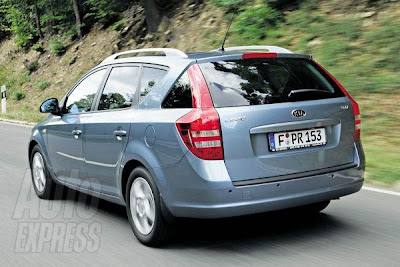
Kia Cee'd SW 2.0 CRDi GS sprouts a load lugger in the shape of the SW-badged estate version

The Kia Cee’d is growing fast. In addition to the five-door hatchback already on sale, an exciting three-door model will reach UK showrooms later this year, and there’s a convertible due in 2008, too.

But if you’re in need of a practical holdall, the company has another var­iant to suit you. Called the SW, it’s the new Cee’d estate, and it hits British dealers in September.

Auto Express drove one of the first examples in Korea in Issue 962, and gave it the thumbs up. Now the newcomer has arrived in Europe, has it got what it takes to beat established load-luggers from Ford and Vauxhall?

Well, the SW is certainly distinctive. Designed in Germany and built in Slo­vakia, the new estate features a sleek tail with a neat cut through the rear windows, similar to those on Peugeot’s 407 SW. And with some chunky, silver-painted roof bars, it looks the part.
2007 Frankfurt Auto Show, 2007 Frankfurt Motor Show, Auto Show, Renault At 4.5 metres, the Cee’d SW is 235mm longer than the five-door. The extra length has been added behind the rear seats. So, although there’s no additional legroom in the back and only a little more headroom, luggage capacity measures 534 litres – nearly 200 litres more than the hatchback.

The seats split 60: 40 and fold completely flat, giving a maximum space of 1,664 litres, which beats the estate versions of the Ford Focus and Vaux­hall Astra. But the SW isn’t simply big. The bootlid hinges have been positioned as far into the roof as possible, which makes the opening enormous.
2007 Frankfurt Auto Show, 2007 Frankfurt Motor Show, Auto Show, Renault Add in minimal wheelarch intrusion and a low loading lip, and it’s easy to get large items into the back. Even if you’re not carrying anything bulky, the SW is still brilliantly practical, as there are handy storage trays underneath the boot floor and lots of hooks. A big cargo net is included, and there’s a 12V power point, too.

Up front, the cabin is unchanged from the five-door’s, which means there’s a reach and rake-adjustable steering wheel, a well built, logically laid-out dashboard and a USB connection for an MP3 player on the centre console. From base S through LS to top GS trim, all models get air-conditioning as standard.

Three 1.6-litre engines – a 120bhp petrol, plus 89bhp and 113bhp diesels – will be available from September. Our test car had a 138bhp 2.0-litre oil burner that is likely to arrive in March. It provides punchy acceleration, is frugal and produces only 154g/km of CO2. Most buyers will be happy with the 113bhp 1.6-litre diesel, though.

On the move, the Cee’d SW has one obvious weakness. Engineers have stiffened the estate’s rear end to cope with extra loads, and this, combined with the already firm suspension set-up, means it’s not the most comfortable car over uneven surfaces.

However, the trade-off for this is good body control, and with accurate steering, the SW feels agile, if ultimately not that much fun. It’s a dec­ent long-distance car, with supportive seats and hardly any road or engine noise making it into the cabin.

So has Kia got a winner on its hands? When you factor in a starting price of around £12,500 for the base S model and a seven-year warranty, the answer has to be yes. The SW is a spacious, practical and well thought-out estate car that’s a worthy addition to the Cee’d range.Rival: Ford Focus 2.0 ZetecThe Focus is more fun to drive and has a higher-quality interior than the Cee’d. But when you look more closely, the Ford isn’t quite such a tempting package – its load area is much smaller and the price around £2,000 higher.

Car Review:Mercedes CLK 500 ISG

When it comes to boosting efficiency in petrol engines, Mercedes is playing catch-up. Premium rival Lexus already has hybrid cars, while BMW offers regenerative braking to improve fuel economy on several models.

But the three-pointed star is working hard to regain ground – and Auto Express has driven its latest development: a CLK 500 with ISG technology.

The initials stand for Integrated Starter/Generator, and in lay terms, the set-up is a stop-start system. A disc-shaped electric motor is added between the engine and automatic transmission, while a secondary battery is charged by regenerative braking and offers a power boost during hard acceleration. The main advantage is that this layout is smaller and lighter than a hybrid transmission.

For the driver, it means fuel economy is up 10 per cent from 24.8mpg to 27.3mpg, while CO2 output is esti­mated to drop by a similar proportion.
Mercedes CLK 500 ISG The stop-start technology cuts the engine when you come to a halt, and fires it up as soon as your right boot comes off the brake. By the time you are pressing the accelerator, it’s as if the V8 has been running all the time.

The powerplant also switches off if you shift the auto box into Park mode.

At least that’s how it’s supposed to work. But in the 30-degree heat of our urban drive in Germany, it didn’t. Despite having several opportunities to cut out as we stopped at traffic lights and junctions, it failed every time.
Mercedes CLK 500 ISG We thought the system wasn’t working properly, but later learned it was because we had turned the CLK’s air-conditioning on. Apparently, the car prioritises driver comfort over saving the planet. On a second run with the cooling system switched off, the ISG technology worked fine.

Arguably, the Mercedes stop/start isn’t as clever as it thinks it is. Yes, it can cut the engine to save fuel, but similar devices offered by rival manufacturers switch off when they realise you are coming to a halt. That means owners get every last mile from the fuel tank by freewheeling to a standstill. What’s more, bosses won’t offer the ISG technology until 2009.

Other Mercedes-Benz Cars:

Lexus RX Getting Bigger And Seven-seat RX coming

Bigger is better at Lexus. Our exclusive picture shows that the next RX will be larger than the current model – and it could even be offered as a seven-seater for the first time.

Despite this, the Japanese firm is likely to take a conservative approach to the newcomer’s styling. It will feature swept-back headlamps and the trademark Lexus grille, while the distinctive curved roof of the existing car will also be retained. Our spy shot (below) shows that the replacement’s underpinnings are already being fine-tuned in a test mule wearing the current SUV’s body.
Lexus RX At first glance, it looks like any other RX, but close inspection reveals that the rear lights no longer sit flush with the bodywork. That’s because the panels have been widened to account for the new platform’s bigger dimensions. This added size could pave the way for an optional third row of seats, which would put the Lexus up against BMW’s X5 when it arrives in dealers in 2009.

The new 4x4 likely to debut at that year’s Tokyo Motor Show because, although the biggest market for the RX is the US, the model will be the first SUV in Japan to wear a Lexus badge. The current generation is called the Toyota Harrier in its home market.
Lexus RX Recent Post:
+ New Audi Q5 Shapes Up

+ Volvo V50 D5 SE Sport Mildly Revised Load Lugger Looks Better, But Does It Load Better?
+ BMW X5 GETS IT RIGHT: Luxury SUV a big improvement from earlier generation
+ 2008 BMW 650i Coupe and Convertible Preview
+ 2008 Mercedes-Benz C-Class: A Step In The Right Direction
+ It's Ferrari's new 'Scud' missile
+ 2007 BMW Alpina B7
+ Full Test: 2007 FPV Ford Falcon GT A Four-Door Mustang From Down Under
+ 2008 Porsche Cayenne S
+ 2007 Porsche 911 Carrera 4S Cabriolet
+ Fleet Update: 2007 Audi Q7 4.2

[source: AutoExpress]