Showing posts with label Drive Experience. Show all posts

First Drive: 2010 Aston Martin Rapide is always ready for its close-up

the starting ceremony complete, the V12 settles into a pleasant rumble. The transmission buttons reside on each side of the arty key. Release the electronic parking brake, press the "D" button, and the Rapide is ready to roll.

Acceleration is strong, but not neck-snapping. Holding the Rapide's accelerator to the floor rewards passengers with 60 miles per hour in just under five seconds – robust, but a number that is no longer very impressive in this stratospheric segment. It is a world filled with forced induction competitors that exhibit immediate torque off idle, yet the Rapide's V12 breathes air at atmospheric pressure. In the real world, most won't care about the numbers as the sound emanating from the 6.0-liter twelve-cylinder engine sends chills decisively down each passenger's spine. The unhampered exhaust spouts gloriously from the twin pipes under throttle, and it burbles during downshifts. In other words, the Rapide offers a sensational bark, but a mid-pack bite.

The Rapide doesn't drive as big as it looks (still, tight slaloms are best done wide to compensate for the added wheelbase). Notwithstanding, any sedan-like driving characteristics are left in the parking lot as the Rapide magically morphs into a coupe at speed and becomes truly enjoyable to command.

2010 Aston Martin Rapide
We covered a couple hundred miles in the Rapide over the course of a day. It was raining most of the time (thank you, Florida), but sealed inside our leather-lined cocoon, we were isolated from everything nature had in store. The platform is remarkably solid, as if it had been CNC-milled from a forged ingot of titanium. Not only is the cabin completely free from squeaks and rattles, but triple-digit velocities allow only a whisper of wind noise to our ears (the window glass is laminated specifically to improve noise insulation).

The paddle shifters, electronically triggering the six-speed automatic, are easy-to-use and very effective in operation. While it is not today's popular dual-clutch setup, the "Touchtronic 2" mated to the V12 cracks off quick shifts enjoyably and without drama. Even in fully automatic mode, we never found ourselves questioning its decisions.

Straight-line speed is effortless in the Rapide, but so are the curves. Again, in coupe-like fashion, the Rapide dives right in without hesitation. Excellent chassis tuning, a responsive automatic damping system and optimal weight distribution make the four-door an absolute joy to toss around. Reigning in the inertia are overly capable brakes. Thanks to the weather, we couldn't find a surface with enough grip to put them to a vigorous test as ABS would stop our game well short of their true threshold. Still, their application was accurate and easy to modulate.

We must mention the stereo as the Aston Martin Rapide has the best mobile audio system we have ever heard – hands down. Yes, it is standard equipment. Credit the Danish Bang & Olufsen team with engineering a 1,000-watt system that pumps auditory bliss out of 15 strategically-placed speakers throughout the cabin (the system is officially called the "1000 W BeoSound Rapide"). Not only does the custom setup include those two ultra-cool "Acoustic Lenses" that rise like dueling conductors out of the dashboard, but the electronics actually monitor each seatbelt to determine how many occupants are in the vehicle (and where they are sitting) so that the sound may be tailored perfectly within the cabin's acoustic chambers – now, that is cool. With our iPhone plugged into the system, we had Rush's Tom Sawyer blaring so loudly that you would have sworn Geddy Lee was wailing at us inches away, Alex Lifeson was strumming in the passenger seat and Neil Peart was hanging out in the rear hatch smashing a full complement of drums. Our ears rang for hours that night.

We genuinely liked the Aston Martin Rapide, but it didn't leave us breathless. A peerless execution of a sedan cleverly disguised as a coupe – or arguably one of the best-looking sedans on the planet – the four-door isn't the sportiest within its niche (the Porsche Panamara takes that honor), or the most luxurious (the Maserati Quattroporte is more swank). However, neither of those cars would win even a first-round beauty contest against the Rapide. With that sole factor in mind, Aston Martin has successfully delivered its objective.

On a level playing field, it is wrong to measure the Rapide against a Panamera or Quattroporte – Aston Martin's objective wasn't to dip into the rarefied sedan segment and skim sales from the Germans or Italians. This British automaker was seeking to offer its exclusive owners a four-passenger option, something it had never truly delivered. Today, an Aston Martin customer standing on a marble showroom floor looking for something a bit larger and more accommodating than a DB9 or DBS, yet with nearly identical driving dynamics, has a viable option. Without compromise, the pampered clientele will steer themselves towards the four-door Rapide.

2010 Aston Martin Rapide 2010 Aston Martin Rapide 2010 Aston Martin Rapide 2010 Aston Martin Rapide 2010 Aston Martin Rapide 2010 Aston Martin Rapide

More about Aston Martin Car in Luxury Autos:
Aston Martin Rapide caught undisguised in parking lot
+ Geneva Motor Show 2009 Preview: Aston Martin DBS Volante the ultimate in alfresco 12-cylinder motoring
+ Aston Martin Vantage get power upgrade

MTM Audi RTT: R8-beating, Bauhaus lunacy

One of the scribes contracted by World Car Fans just wrapped up some seat time in the supercharged MTM Audi RTT, and says, despite the love-fest going on over the Audi R8, its MTM-massaged baby brother can give it more than a run for its money.

Focusing more on outright speed than competent handling, our tuner tour guide provides us a straight-forward account of the RTT's accelerative qualities, citing a 0-62 MPH time of 4.1 seconds, a half-second less than Audi's high-dollar mid-engine masterpiece. Beyond the blower, which brings output up to 415 HP and 368 lb.-ft. of torque, the RTT also benefits from an R8-inspired body kit (€2000), although surprisingly, MTM has left the stock suspension in its place – something they'll rectify with the right amount of cash.

With an entry fee of just under €73,000, it certainly isn't for the faint of heart. But then again, neither is its performance.

[Source: World Car Fans]

MTM Audi RTT: R8

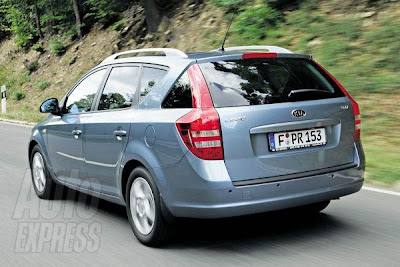
Kia Cee'd SW 2.0 CRDi GS sprouts a load lugger in the shape of the SW-badged estate version

The Kia Cee’d is growing fast. In addition to the five-door hatchback already on sale, an exciting three-door model will reach UK showrooms later this year, and there’s a convertible due in 2008, too.

But if you’re in need of a practical holdall, the company has another var­iant to suit you. Called the SW, it’s the new Cee’d estate, and it hits British dealers in September.

Auto Express drove one of the first examples in Korea in Issue 962, and gave it the thumbs up. Now the newcomer has arrived in Europe, has it got what it takes to beat established load-luggers from Ford and Vauxhall?

Well, the SW is certainly distinctive. Designed in Germany and built in Slo­vakia, the new estate features a sleek tail with a neat cut through the rear windows, similar to those on Peugeot’s 407 SW. And with some chunky, silver-painted roof bars, it looks the part.
2007 Frankfurt Auto Show, 2007 Frankfurt Motor Show, Auto Show, Renault At 4.5 metres, the Cee’d SW is 235mm longer than the five-door. The extra length has been added behind the rear seats. So, although there’s no additional legroom in the back and only a little more headroom, luggage capacity measures 534 litres – nearly 200 litres more than the hatchback.

The seats split 60: 40 and fold completely flat, giving a maximum space of 1,664 litres, which beats the estate versions of the Ford Focus and Vaux­hall Astra. But the SW isn’t simply big. The bootlid hinges have been positioned as far into the roof as possible, which makes the opening enormous.
2007 Frankfurt Auto Show, 2007 Frankfurt Motor Show, Auto Show, Renault Add in minimal wheelarch intrusion and a low loading lip, and it’s easy to get large items into the back. Even if you’re not carrying anything bulky, the SW is still brilliantly practical, as there are handy storage trays underneath the boot floor and lots of hooks. A big cargo net is included, and there’s a 12V power point, too.

Up front, the cabin is unchanged from the five-door’s, which means there’s a reach and rake-adjustable steering wheel, a well built, logically laid-out dashboard and a USB connection for an MP3 player on the centre console. From base S through LS to top GS trim, all models get air-conditioning as standard.

Three 1.6-litre engines – a 120bhp petrol, plus 89bhp and 113bhp diesels – will be available from September. Our test car had a 138bhp 2.0-litre oil burner that is likely to arrive in March. It provides punchy acceleration, is frugal and produces only 154g/km of CO2. Most buyers will be happy with the 113bhp 1.6-litre diesel, though.

On the move, the Cee’d SW has one obvious weakness. Engineers have stiffened the estate’s rear end to cope with extra loads, and this, combined with the already firm suspension set-up, means it’s not the most comfortable car over uneven surfaces.

However, the trade-off for this is good body control, and with accurate steering, the SW feels agile, if ultimately not that much fun. It’s a dec­ent long-distance car, with supportive seats and hardly any road or engine noise making it into the cabin.

So has Kia got a winner on its hands? When you factor in a starting price of around £12,500 for the base S model and a seven-year warranty, the answer has to be yes. The SW is a spacious, practical and well thought-out estate car that’s a worthy addition to the Cee’d range.Rival: Ford Focus 2.0 ZetecThe Focus is more fun to drive and has a higher-quality interior than the Cee’d. But when you look more closely, the Ford isn’t quite such a tempting package – its load area is much smaller and the price around £2,000 higher.

Volvo V50 D5 SE Sport Mildly Revised Load Lugger Looks Better, But Does It Load Better?

Sporty, stylish and practical – the new Volvo V50 is as versatile as a Swiss army knife. But can it cut through the competition on UK roads?

The Swedish brand has revised its smallest estate range with the addition of two new engines. Along­side a fresh entry-level 2.0-litre petrol unit, there’s now the option of the potent D5 diesel powerplant for the first time.

Cosmetic revisions are limited, and only true Volvo fans will spot the wider grille, plus the revamped light covers and bumper at the front. It’s much the same story at the back, where new lamp clusters featuring LED bulbs are the only obvious difference.

None of this is bad news, though, because the V50 has always been a handsome estate. Unfortunately, it’s never been a particularly big one – and, disappointingly, the modest 417-litre boot capacity is the same as on the previous model. At least it expands to a more useful 1,307 litres with the rear seats folded down.

Opt for the SE Sport trim of the car we drove, and you get large 18-inch wheels and a full bodykit to help set your V50 apart from lesser variants. The cabin also features leather upholstery and some of the most comfortable seats on the market.

Inside, storage is improved, thanks to large door bins, while solid build qual­ity and superior materials reinforce the V50’s premium feel.

V50 D5 SE Sport Our test car also had the advanced Blind Spot Information System (BLIS). At £650 it’s not cheap, but the clever set-up alerts the driver to objects in the over-the-shoulder blind spot.

Rear-facing digital cameras mounted in the door mirrors monitor the areas where your vision is restricted, and flash warning lights positioned on the A-pillars if it’s unsafe to change lanes. The same system is available in the XC90, and although it takes some getting used to, it eases some of the strain of motorway driving.
 V50 D5 SE Sport In comparison, the D5 engine is a familiar piece of technology that has been tried and tested in cars across the Volvo model range. The power output has been reduced for the V50, although it still produces 178bhp and 350Nm of torque – which is enough to propel the revised load-lugger from 0-62mph in 7.9 seconds.

Thanks largely to its five-cylinder configuration, the oil-burner also has a distinctive growl – but under full throttle the noise is all too noticeable. Once cruising, refinement improves, making the Volvo a relaxed motorway cruiser.
 V50 D5 SE Sport Sport models like ours come fitted with a chassis package designed to improve handling – although as the V50 shares underpinnings with the Ford Focus, it’s stable and sure-footed anyway. Unfortunately, the steering feels a little numb. Still, the Volvo is composed in bends, and despite its large 18-inch alloy wheels, the V50’s ride is impressive. Combine this with the brand’s smooth Geartronic automatic transmission, and the estate is a soothing car to drive.

Although lower-spec variants argu-ably make more sense than the top-of-the-range SE Sport, the revised V50 is a desirable family car. Overall, it’s a solid alternative to contenders from the likes of Honda, Saab and BMW.

But it’s not cheap. If you want your Volvo with as much equipment as the option-laden model here, you will have to spend £30,240! It’s not difficult to find cheaper alternatives with more tempting prices.

Recent Post:
+ BMW X5 GETS IT RIGHT: Luxury SUV a big improvement from earlier generation
+ 2008 BMW 650i Coupe and Convertible Preview
+ 2008 Mercedes-Benz C-Class: A Step In The Right Direction
+ It's Ferrari's new 'Scud' missile
+ 2007 BMW Alpina B7
+ Full Test: 2007 FPV Ford Falcon GT A Four-Door Mustang From Down Under
+ 2008 Porsche Cayenne S
+ 2007 Porsche 911 Carrera 4S Cabriolet
+ Fleet Update: 2007 Audi Q7 4.2

[source:http://www.autoexpress.co.uk/carreviews/firstdrives/209707/volvo_v50.html]

Full Test: 2007 FPV Ford Falcon GT A Four-Door Mustang From Down Under

We Aussies find it amusing that our most American-inspired cars turn out to be so inspiring to Americans. As you've heard, General Motors is plugging a gap in its performance credibility with the Australian-built Holden Commodore SS, which will become the 2008 Pontiac G8.

It seems to us that the 2007 Ford Falcon GT would be a good choice for you Yanks as well. Ford's Interceptor Concept from the 2007 Detroit Auto Show and its 427 concept from the 2003 Detroit show suggest Dearborn also has a hankering for a full-size, rear-wheel-drive, high-performance sedan, and the Ford Falcon here in Australia is the most obvious candidate.

The large, rear-drive V8-powered sedan took root here in the Antipodes exactly 40 years ago, when Ford Australia introduced its Mustang-bred Falcon XR GT 289. Since then, an environment of sunshine, beer and barbecues has made the Falcon the kind of car that should be sold in America.

And You Thought NASCAR Came From the Deep South

Ford might squander the credibility of its nameplates in other countries, but the "Falcon GT" moniker has never been used lightly at Ford Australia. The seminal 1967 Falcon XR GT went right into competition once it was launched and finished 1st and 2nd in the annual Bathurst 500-mile touring car race. The victory prompted Holden to fight back with its first Monaro, using an imported Chevrolet 327-cid V8 in its Bathurst racer.

Epic battles between the Falcon and Monaro ensued through the 1970s, until Ford Australia unwisely dropped its V8 option from the Falcon range in November 1982. It was 10 years before the Ford V8 (known as the "blue bent-eight" by the locals) came back into production, losing a whole generation of Ford buyers to performance-minded Holden.

So influential and fondly remembered is the original Falcon GT that a low-mileage yet historically unremarkable example of the 1971 XY Falcon GTHO Phase 3 — in its day, the world's fastest four-door — sold at auction for a record U.S. $567,293. Makes you wonder what the Falcon driven by Max Rockatansky (you know, Mad Max) would fetch.

2007 FPV Ford Falcon GT The Flight of the Falcon

As with the Holden Commodore, these days the Ford Falcon does most of its business as a six-cylinder fleet-and-family car. In fact, V8 variants constitute roughly 15 percent of each car's sales. Holden uses the 6.0-liter pushrod LS2 imported for this purpose, while Ford has a locally assembled 5.4-liter SOHC unit.

Your Falcon enthusiast can choose among a 310-horsepower 24-valve SOHC V8, 350-hp 32-valve DOHC performance Falcon XR8 or a turbocharged 330-hp inline-6 XR6 Turbo.

And then there are the image-making, limited-edition Falcons from factory-owned hot-rod shops like Ford Performance Vehicles (FPV). Back in 2003, FPV partnered with ProDrive (the English motorsports engineering specialist) and finally got Ford's performance-brand image together. Today the collaboration supplies FPV with a range of sedans powered by either a 362-hp version of the turbocharged inline-6 or a 389-hp DOHC V8.
2007 FPV Ford Falcon GTEmotional Engineering
Named for its output in kilowatts, the "Boss 290" engine in our bright-orange FPV Ford Falcon GT test car is a transpacific freak. The 5.4-liter V8 uses a Mustang Cobra R block and 32-valve DOHC cylinder heads from America, while the pistons, bearings, inlet manifold and exhaust headers are sourced in Australia.

FPV maintains that it doesn't want to get involved in a horsepower war with Holden Specialty Vehicles (HSV), which is an elegant way of conceding defeat before you've even left the showroom. While FPV's slogan of "total performance" applies to the well-integrated package of accessories worn by this Falcon GT, the hardware isn't especially exciting.

There's the engine, for instance. With not much happening underfoot until the tachometer needle swings past 3,500 rpm, you're thinking this quad-cam V8 must be a screamer. But no sooner has the V8 begun to come alive than it gets breathless beyond 5,500 rpm and finally splatters against the rev limiter at 6,000 rpm.

There's no alternative but to dip the long-throw clutch pedal again and have a grumble through the knuckly gate of the six-speed manual transmission. The first four cogs are nicely useful, but the direct-drive 5th and overdrive 6th leave the V8 snoozing at the 70-mph speed limit ruthlessly enforced on Australian freeways.

With a 0-60-mph time of 5.7 seconds and a quarter-mile run of 14.5 seconds at 98.9 mph, the Falcon GT is slower than the Holden Commodore SS, which itself gets to 60 mph in 5.3 seconds on its way to the quarter-mile in 14.1 seconds at 99.1 mph.
2007 FPV Ford Falcon GT You've Mellowed These Last 40 Years
In many ways, however, the Falcon GT is admirably swift and competently composed.

Most remarkable is the ride quality, as it's very comfortable across all but the most patchy surfaces, where the body control begins to suffer from the combination of limited suspension travel and soft rebound damping. It's a useful achievement considering the car's aggressive 245/35R19 tires.

In GT trim, the Falcon's double-wishbone front suspension and independent multilink rear suspension get a lower ride height with unique springs, dampers and antiroll bar. But the Falcon's curb weight of 4,090 pounds sabotages the car's handling at the limit. One also has to remember that this is a big car: just a fraction of an inch shorter than the .

We managed a slalom run of 64.9 mph and then recorded 0.84g around the skid pad. The Ford is agile enough to be entertaining, but not swift enough to keep up with the Holden's 67.6-mph slalom speed and its 0.87g skid pad performance.

The Falcon's steering isn't fazed much by road undulations and its turn-in is consistent and quick, but the thick-rimmed steering wheel transmits more hydraulic effort than road feel. The seats feel good, though the support is compromised by the need to accommodate our big, beefy Aussie frames.


We Don't Slow Down Much in Australia
Even these bold, baboon-butt Brembo brakes don't deliver fully on their promise. While pedal modulation feels great, the Falcon GT came to a stop from 60 mph in 122 feet, 5 feet longer than the stop recorded by the Holden Commodore SS we tested on the same day. It seems like a disappointing performance from such an expensive brake package with six-piston front calipers and four-piston rears.

Slightly oversensitive calibration of the ABS also flusters braking performance over road ripples, making apex-picking a challenge during press-on, open-road punting.

Well, all of that's true in Australia, anyway. Our roads vary from divided highways to wandering tracks across the Outback, so it's easy to turn up the compromises that must be built into a platform that must be sufficiently tough for daily dirt-road use, yet sophisticated enough to aspire to the performance of a European sport sedan.

You know what it is? The Falcon GT's shortcomings are the things that make it feel to Australian drivers as if it's a bit, well, American.

Winging Its Way to Where?
The Aussie Falcon's future has been debated for about as long as Dearborn has lacked a decent platform for a large rear-drive sedan.

It seems that each new generation of the Falcon is predicted to be its last, as smaller international platforms (like the DEW98 platform beneath the current Ford Mustang and Jaguar S-Type) are constantly tipped to replace this Aussie-engineered production, which is as old as grandfather's axe.

Next to the VE Commodore, however, the Falcon does feel a generation older. That's why a substantial revision of the Falcon platform is due next year, we're told. Apparently Ford will address the Falcon's dull feel from the front tires with a stronger front subframe, new lower wishbones for the front suspension and a new steering system.


Almost certainly, however, this new car will be the last unique, all-Aussie Falcon. The next-generation platform, due around 2012, will be shared with Ford's rear-drive U.S. models. If we're lucky, Dearborn will have learned a few things from the Aussies by then.


[sourcing: http://www.edmunds.com/]

2007 Porsche 911 Carrera 4S Cabriolet

Toronto, Ontario - Increasingly (and especially in my corner of Southern Ontario) it’s getting harder and harder to exercise a sporting vehicle on public roads. Not that I’m condoning irresponsible driving, but short of a few bursts of acceleration, or the odd off-ramp hi-jinx, there’s precious little fun to be had around here.

In reality, keeping a high performance sports car in this environment is akin to caging a cheetah or confining Shaque to shooting hoops in your driveway..

Which is precisely why the 2007 $136,900 355-hp Porsche 911 Carrera 4S Cabriolet make so much sense.

Huh? Bear with me dear reader.

For sure, this iconic 911 all-wheel drop-top has serious tarmac-chewing capability, but for those times when you’re not attacking your favourite back road test loop, it does a fine job of creating the illusion of speed.

Case in point: With the top down and my youngsters squeezed in the back “seats” of this Guards Red tester, we made a run to the shops. “Dad! Slow down!!!” they squealed in delight. I looked down at the big digital speedometer. It read 65 km/h.
2007 Porsche 911 Carrera 4S Cabriolet Okay, so I had reached that speed in an eye-blink, but had we been in an equally swift sedan, my kids wouldn’t have flinched.

In the Porsche, the firm ride, the rushing air, and of course that marvellous 3.8-litre flat-six snorting away inches from their backsides conspired to make the little tykes think Dad was going for his best lap at the Nurburgring.

And isn’t that what the sports car experience is all about?

Driving this al fresco Porsche allows one to take in every nuance of the DOHC 24-valve engine. And what a repertoire it has. Just off idle it gurgles and spits like Tom Waits after a night of drinking cleaning products. Around 2000 r.p.m. the big six clears its throat and from there it builds from a baritone warble to a mellifluous wail as the 7200 r.p.m. red-line rapidly approaches.And then there’s second gear.
2007 Porsche 911 Carrera 4S Cabriolet My tester was equipped with a six-speed manual transmission, which shifts with a firm and precise manner. Similarly, the clutch requires a manly prod and the steering has a meaty feel at low speeds. As in all Porsches, the feel and operation of the major controls are wonderfully integrated, and become more so as your speed increases. The standard leather seats with powered backrest are a paragon of comfort and firm lateral support. Height and for-aft adjustment is manual. If you want them powered or heated, have your wallet handy. Although the rear seats are tiny, they are usable for small children and, as I discovered, those few adults who will suffer anything just to get a ride in a Porsche .

A big tach is central in the five-gauge instrument cluster, with the numbers illuminated in a crisp, eye-friendly white. The digital speedo readout in the lower half of the tachometer benefits from the big white numerals too, which is a good thing. Believe me, you want to know how fast you’re going at all times in this road rocket, and the small speedometer to the left of the tach, with it’s markings in tight 50 km/h increments, is no help.
2007 Porsche 911 Carrera 4S Cabriolet My tester was fitted with the $1950 optional Bose High End Sound Package which sounded good – but not spectacular. But really, the only song you want to hear (and most of the time it’s you’re only choice) is the lusty mechanical symphony of this ass-engined rocket.

Once free from the city confines, the C4S Cabrio comes into its own. I prefer the all-wheel-drive 911s, as they feel more planted and have a more neutral disposition when negotiating the twisties. Which is not to say the steering doesn’t come alive in your hands and the back end can’t be coaxed into some gentle over-steer like in the rear-wheel drive cars. For those into heel-and-toe downshifting, the pedals are perfectly placed for your dancing pleasure. The vented and cross-drilled discs squeezed by four-piston fixed alloy calipers provide the expected Porsche stopping power.


All “S” model Carreras, which carry a 355 hp and 295 lb.-ft. “VarioCam Plus” 3.8-litre aluminum flat-six, beyond the rear axles, also come fitted with Porsche Active Suspension Management. This two-stage damping system takes the chop out of the ride but firms things up the instant you get playful. When PASM is put in sport mode, the suspension buttons down, throttle response quickens and the PSM allows for more sideways fun before it intervenes.

As far as structural rigidity goes, the C4S get a B+: rough surfaces will send some quivers through the structure. It’s not bad, but the standard in convertible stiffness has risen considerably in the past couple of years, and the 911 falls behind such robust roadsters as the Jaguar XKR, M-B SLK and even its baby-brother, the Boxster.

But the occasional shake is a minor price to pay for the dividends received in visual and aural stimulation. Maybe it was the Cabrio’s red paint and tan leather interior, or maybe it was the fact that this was our first truly summer-like weather, but the during my week of piloting this Porsche C4S Cabrio I received more smiles, more thumbs up, and more people yelling “Nice car!” than in any press car I can remember.

While pulling up to a stop sign in my neighborhood, a wide-eyed young whipper-snapper on a bike hollered, “Awesome Porsche! Gun it!” Which I did. Up to 65 km/h. I saw him grinning like the Cheshire Cat in my rear-view mirror.