The Kia Cee’d is growing fast. In addition to the five-door hatchback already on sale, an exciting three-door model will reach UK showrooms later this year, and there’s a convertible due in 2008, too.
But if you’re in need of a practical holdall, the company has another variant to suit you. Called the SW, it’s the new Cee’d estate, and it hits British dealers in September.
Auto Express drove one of the first examples in Korea in Issue 962, and gave it the thumbs up. Now the newcomer has arrived in Europe, has it got what it takes to beat established load-luggers from Ford and Vauxhall?
Well, the SW is certainly distinctive. Designed in Germany and built in Slovakia, the new estate features a sleek tail with a neat cut through the rear windows, similar to those on Peugeot’s 407 SW. And with some chunky, silver-painted roof bars, it looks the part. At 4.5 metres, the Cee’d SW is 235mm longer than the five-door. The extra length has been added behind the rear seats. So, although there’s no additional legroom in the back and only a little more headroom, luggage capacity measures 534 litres – nearly 200 litres more than the hatchback.
The seats split 60: 40 and fold completely flat, giving a maximum space of 1,664 litres, which beats the estate versions of the Ford Focus and Vauxhall Astra. But the SW isn’t simply big. The bootlid hinges have been positioned as far into the roof as possible, which makes the opening enormous.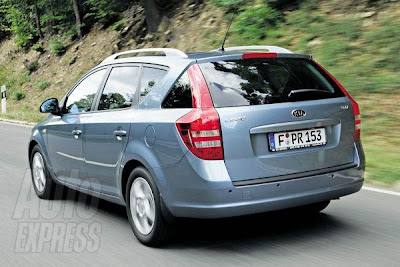 Add in minimal wheelarch intrusion and a low loading lip, and it’s easy to get large items into the back. Even if you’re not carrying anything bulky, the SW is still brilliantly practical, as there are handy storage trays underneath the boot floor and lots of hooks. A big cargo net is included, and there’s a 12V power point, too.
Up front, the cabin is unchanged from the five-door’s, which means there’s a reach and rake-adjustable steering wheel, a well built, logically laid-out dashboard and a USB connection for an MP3 player on the centre console. From base S through LS to top GS trim, all models get air-conditioning as standard.
Three 1.6-litre engines – a 120bhp petrol, plus 89bhp and 113bhp diesels – will be available from September. Our test car had a 138bhp 2.0-litre oil burner that is likely to arrive in March. It provides punchy acceleration, is frugal and produces only 154g/km of CO2. Most buyers will be happy with the 113bhp 1.6-litre diesel, though.
However, the trade-off for this is good body control, and with accurate steering, the SW feels agile, if ultimately not that much fun. It’s a decent long-distance car, with supportive seats and hardly any road or engine noise making it into the cabin.
So has Kia got a winner on its hands? When you factor in a starting price of around £12,500 for the base S model and a seven-year warranty, the answer has to be yes. The SW is a spacious, practical and well thought-out estate car that’s a worthy addition to the Cee’d range.Rival: Ford Focus 2.0 ZetecThe Focus is more fun to drive and has a higher-quality interior than the Cee’d. But when you look more closely, the Ford isn’t quite such a tempting package – its load area is much smaller and the price around £2,000 higher.
+ New Audi Q5 Shapes Up
+ Lexus RX Getting Bigger And Seven-seat RX coming
+ Volvo V50 D5 SE Sport Mildly Revised Load Lugger Looks Better, But Does It Load Better?
+ BMW X5 GETS IT RIGHT: Luxury SUV a big improvement from earlier generation
+ 2008 BMW 650i Coupe and Convertible Preview
+ 2008 Mercedes-Benz C-Class: A Step In The Right Direction
+ It's Ferrari's new 'Scud' missile
+ 2007 BMW Alpina B7
+ Full Test: 2007 FPV Ford Falcon GT A Four-Door Mustang From Down Under
+ 2008 Porsche Cayenne S
+ 2007 Porsche 911 Carrera 4S Cabriolet
+ Fleet Update: 2007 Audi Q7 4.2


